
Even With Batteries and Bitcoin Volatility, the Conclusion Does Not Change
A common objection to flexible monetization through Bitcoin mining sounds reasonable on the surface: “Yes, but now we have batteries.” “Yes, but Bitcoin prices are volatile.” These points are often presented as disqualifying arguments — as if the moment batteries are added, or Bitcoin prices fall, the entire system logic collapses. It doesn’t. In fact, when batteries and Bitcoin volatility are modeled correctly, they reinforce the same conclusion: Grid-first, single-exit energy systems remain structurally fragile. Flexible monetization remains essential.
ENERGY CONTROL SYSTEMS
Chris Boubalos
1/7/2026
Batteries Are Now Standard — And That Changes Nothing Fundamental
Let’s start with batteries.
In 2025, battery storage is no longer optional.
It is a baseline assumption.
Every serious renewable project now includes:
short-duration storage
grid-support batteries
peak-shifting capability
Batteries solve electrical problems:
frequency regulation
short-term mismatch
peak smoothing
They do not solve economic problems.
This distinction matters.
As discussed in Flexible Monetization Is the New Baseload, baseload was never about electrons — it was about economic certainty. Batteries move electrons. They do not guarantee value capture.
What Batteries Can — and Cannot — Do
Batteries are excellent at:
shifting energy minutes to hours
improving grid stability
capturing short-term price spreads
They are structurally incapable of:
absorbing seasonal oversupply
protecting against prolonged low-price regimes
stabilizing revenues across years
creating an economic floor
In oversupplied systems, batteries simply delay the same problem.
Energy stored today must still be sold tomorrow — often into the same saturated market.
Batteries smooth volatility.
They do not eliminate it.
Batteries Optimize the Grid — Not the Asset
This is the key misunderstanding.
Batteries primarily benefit grid operators:
smoother dispatch
fewer constraints
better reliability
But for the asset owner, batteries do not change the core exposure:
prices can still collapse
curtailment still exists
grid dependency remains
Adding batteries to a grid-first system is an incremental improvement, not a structural fix.
The exit path is still singular.
Now Let’s Address Bitcoin Downside Volatility
The second objection is Bitcoin itself:
“What happens when Bitcoin price drops 50%?”
This question assumes Bitcoin mining is being used as:
a speculative profit engine
a primary revenue driver
a price-directional bet
That is not how it functions in system design.
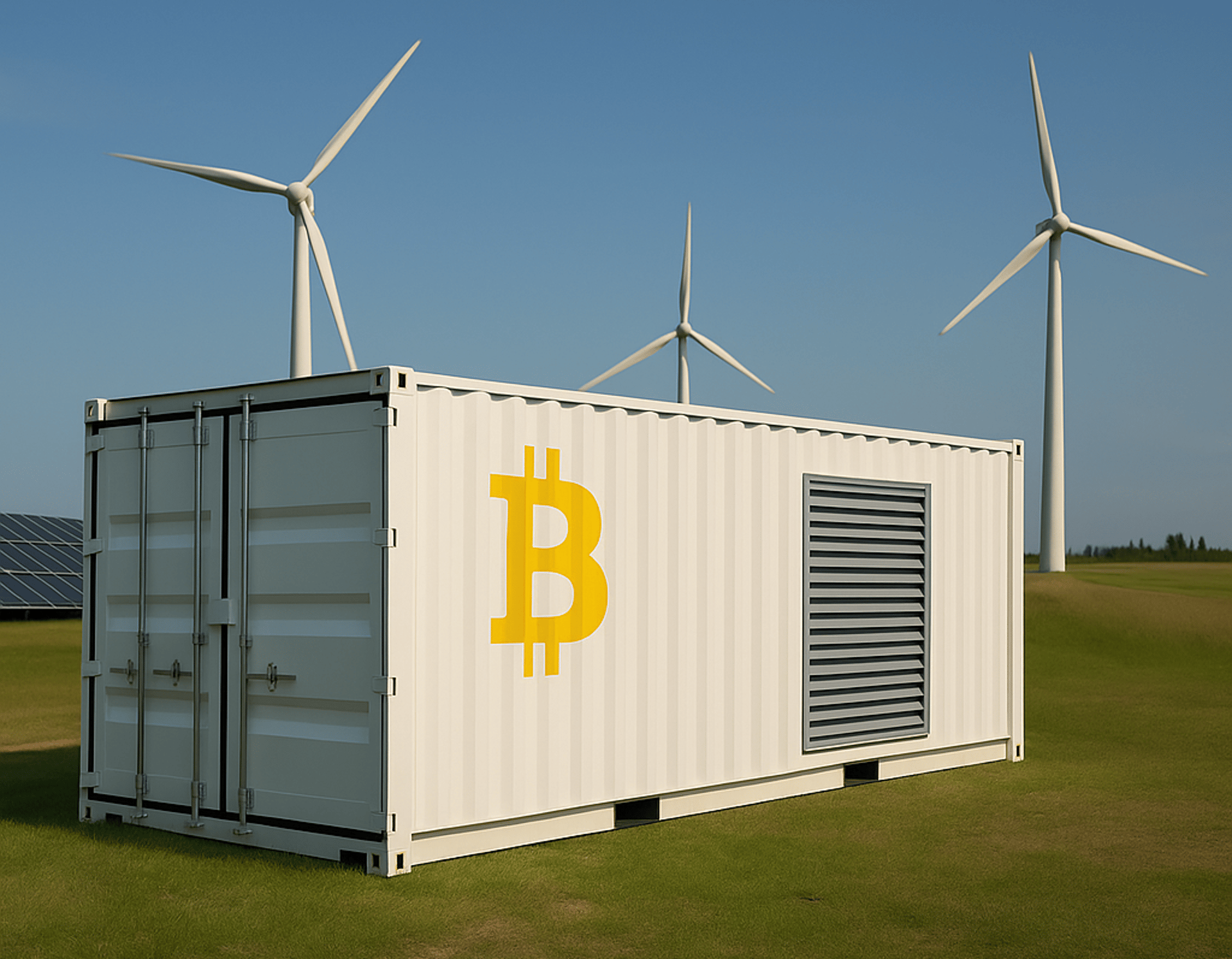
As outlined in Bitcoin Mining Is Not a Business — It’s a Control System, mining is not introduced to maximize upside. It is introduced to prevent value destruction.
Mining Is a Revenue Floor, Not a Price Bet
In properly designed systems, Bitcoin mining:
absorbs energy that would otherwise be curtailed
monetizes energy priced at zero or negative
operates only when marginal cost is minimal
When Bitcoin price falls:
mining scales down
hash difficulty adjusts
marginal operators exit
The system self-balances.
The relevant comparison is not:
“Is Bitcoin price high?”
It is:
“Is this energy otherwise worthless?”
If the alternative is curtailment, Bitcoin volatility does not negate the logic — it defines the boundary conditions.
Volatility Does Not Break Optionality — It Proves It
Optionality is designed precisely for volatile environments.
A flexible monetization layer:
does not require constant operation
does not rely on price forecasts
does not collapse under downside scenarios
When Bitcoin prices are high, it captures upside.
When prices fall, it preserves downside protection.
This is not speculation.
It is risk asymmetry.
Batteries + Mining: Complementary, Not Competing
The mistake is framing batteries against mining.
They operate on different dimensions.
Batteries shift time within the grid
Mining shifts value outside the grid
Together, they create a layered system:
batteries handle short-term physics
mining handles long-term economics
Neither replaces the other.
As discussed in Designing Energy Systems for Optionality, Not Efficiency, resilient systems use multiple layers to absorb different types of uncertainty.
What Actually Changes When You Add Both
When you model a system with:
batteries included
Bitcoin downside volatility included
Three things become clear:
Grid dependence remains the dominant risk
Single-exit design still fails under abundance
Flexible monetization remains the only structural hedge
The presence of batteries improves performance at the margin.
Bitcoin volatility constrains upside.
Neither invalidates the system logic.
The Error of Perfect-Condition Thinking
Most critiques assume ideal conditions:
rational markets
stable pricing
perfect forecasting
permanent grid upgrades
Energy systems do not operate under ideal conditions.
They operate under:
policy shocks
demand swings
weather volatility
infrastructure lag
Designing systems that only work when conditions are favorable is not conservative.
It is reckless.
Why the Conclusion Does Not Change
Even after accounting for:
battery storage as a standard component
Bitcoin price volatility to the downside
The conclusion remains the same:
Energy systems require multiple exit paths.
Control must exist outside the grid.
Optionality is non-negotiable.
This is not a Bitcoin argument.
It is an infrastructure argument.
The Entropy888 System View
At Entropy888, batteries are treated as necessary infrastructure — not as a substitute for economic control.
Bitcoin mining is integrated as a flexible monetization layer that operates only when it improves system resilience, not when it increases speculative exposure.
The objective is not to outperform in bull markets.
It is to survive all market conditions.
Conclusion: Robust Systems Assume Reality, Not Perfection
The future energy system is not built for best-case scenarios.
It is built for:
oversupply
volatility
political friction
imperfect markets
Batteries help.
Bitcoin fluctuates.
Neither changes the structural truth.
Energy systems designed with optionality endure.
Those designed around a single exit — even with batteries — eventually fail.
The math does not change.
Only the excuses do.
Contact
© 2025 Entropy888. All rights reserved.
Powered by Renewable Energy.
Christos Boubalos - Business Development Lead +306972 885885 mob/whatsapp
christos@entropy888.com
-------------------------------------------
General Enquiries - info@entropy888.com