
Bitcoin Mining Is Not a Business — It’s a Control System
For years, Bitcoin mining has been framed as a business. Revenues, costs, hashrate, efficiency, ROI. This framing is not just incomplete — it is actively misleading. Bitcoin mining is not fundamentally a profit-seeking activity in the traditional sense. It is not comparable to manufacturing, services, or even energy production. When treated purely as a “business,” mining appears volatile, cyclical, and fragile. But when viewed correctly, Bitcoin mining reveals its true nature: It is a control system. And control systems are not built to maximize short-term profit. They are built to stabilize, absorb shocks, and preserve optionality under uncertainty.
ENERGY CONTROL SYSTEMS
Chris Boubalos
1/2/2026
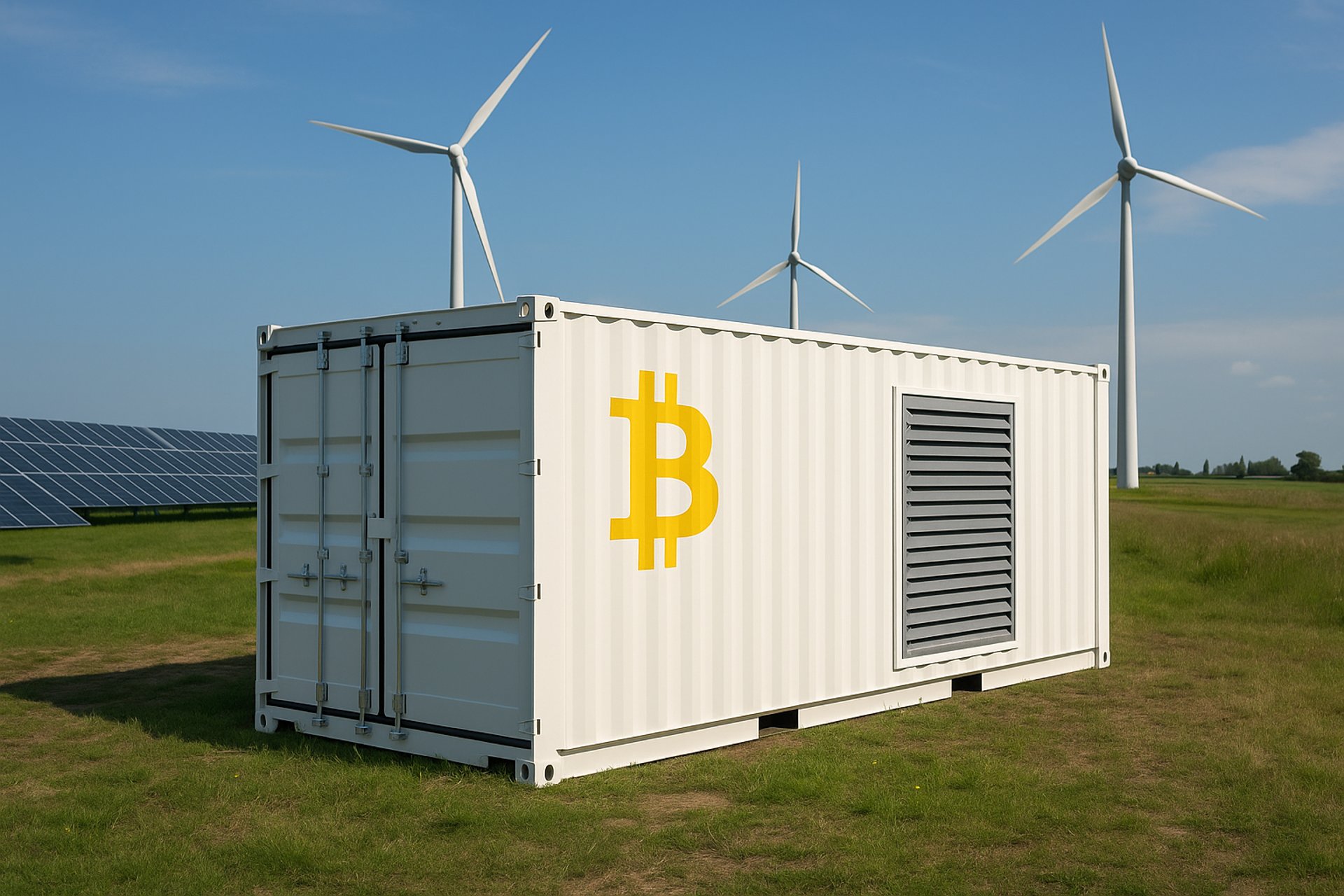
The Misunderstanding at the Core
Modern energy systems are failing for one primary reason:
they were designed for scarcity, not abundance.
Electric grids evolved around predictable generation, centralized dispatch, and rigid demand. Renewable energy breaks every one of those assumptions. Solar and wind are intermittent. Hydro is seasonal. Production increasingly exceeds demand — not because of excess, but because demand cannot respond.
This mismatch creates volatility:
price collapses
curtailment
negative pricing
stranded assets
unstable cash flows
The common response has been optimization:
more forecasting, better batteries, smarter markets, tighter regulation.
But optimization assumes stability.
What renewable systems actually face is structural instability.
This is where Bitcoin mining enters — not as a business, but as a control mechanism.
What Control Systems Actually Do
In engineering, a control system does not create value directly.
It regulates behavior within a system to keep it within viable boundaries.
A good control system:
absorbs excess
responds instantly
stabilizes outputs
reduces variance
prevents runaway failure
Bitcoin mining does all of this — but economically, not mechanically.
It converts excess, unpriced, or destabilizing energy into:
a liquid digital asset
stored economic value
time-shifted optionality
Mining does not compete with the grid.
It protects the grid from its own rigidity.
Why Treating Mining as a Business Breaks It
When mining is treated as a standalone business, operators chase:
lowest $/kWh
maximum uptime
peak efficiency (J/TH)
constant operation
This mindset creates fragility.
Mining rigs placed without regard to grid conditions, energy volatility, or long-term integration become exposed to:
regulatory backlash
price compression
infrastructure conflicts
social opposition
Worse, they add stress instead of removing it.
A true control system behaves differently:
it turns off when needed
it absorbs volatility instead of amplifying it
it sacrifices utilization for resilience
it values optionality over optimization
Mining that cannot shut down is not a control system.
It is just another load.
Control Beats Optimization in Unstable Systems
Optimization works in closed, predictable environments.
Energy systems are no longer closed or predictable.
Weather volatility, geopolitical shocks, electrification, AI demand, and policy uncertainty have transformed energy into a non-linear system.
In non-linear systems:
maximizing efficiency increases fragility
tight coupling causes cascading failures
optionality outperforms precision
Bitcoin mining introduces a flexible demand layer that:
absorbs surplus instantly
disappears when energy is scarce
monetizes volatility instead of suffering from it
This is not about mining Bitcoin cheaply.
It is about controlling energy behavior across time.
Mining as Economic Shock Absorber
Traditional energy storage stores electrons.
Bitcoin mining stores economic value.
This distinction matters.
Batteries are finite, capital-intensive, and location-bound. Mining converts surplus energy into an asset that can:
be held indefinitely
moved globally
deployed strategically
reinvested flexibly
In this sense, mining functions as:
energy insurance
revenue floor
volatility buffer
balance-sheet stabilizer
Not a generator of speculative upside — but a protector against downside risk.
Why Energy Owners Are the Natural Operators
The next phase of Bitcoin mining will not be dominated by miners.
It will be controlled by energy owners.
Why?
Because control systems belong where system-level decisions are made:
behind the meter
at generation points
inside infrastructure planning
integrated into grid logic
Energy producers understand:
curtailment risk
negative pricing
seasonal volatility
regulatory exposure
For them, mining is not “crypto exposure.”
It is risk management infrastructure.
Those who treat mining as a speculative add-on will lose.
Those who design it as a control layer will dominate.
Control Systems Don’t Chase Peaks — They Prevent Collapse
The most dangerous misconception is believing mining exists to maximize revenue.
Its real function is to:
prevent value destruction
stabilize long-term returns
smooth cash flows
preserve strategic flexibility
In energy systems, survival beats optimization.
A project that earns slightly less but never collapses outperforms one that peaks and fails.
Bitcoin mining, correctly designed, does exactly that.
From Business to Infrastructure
Once mining is understood as a control system, everything changes:
ROI becomes secondary to resilience
uptime becomes conditional
efficiency becomes contextual
size becomes less important than placement
strategy replaces speculation
Mining stops being “something you run”
and becomes something your system uses.
This is the transition from business logic to infrastructure logic.
The Entropy Perspective
Entropy cannot be eliminated.
It can only be managed.
Renewable energy increases entropy in markets by introducing variability, abundance, and price instability. Bitcoin mining does not fight this reality — it channels it.
By converting uncontrolled energy surplus into structured economic value, mining reduces systemic disorder.
Not by force.
By design.
Conclusion: Control Is the Real Scarcity
Energy is becoming abundant.
Compute is becoming cheap.
Capital is mobile.
What remains scarce is control.
Bitcoin mining is not valuable because it produces Bitcoin.
It is valuable because it allows energy systems to remain functional under abundance.
Those who understand this will stop asking:
“Is mining profitable?”
And start asking the right question:
“Does my energy system have control?”
That is where the future belongs.
At Entropy888, Bitcoin mining is approached not as a standalone business, but as an integrated control layer within renewable energy systems.
Contact
© 2025 Entropy888. All rights reserved.
Powered by Renewable Energy.
Christos Boubalos - Business Development Lead +306972 885885 mob/whatsapp
christos@entropy888.com
-------------------------------------------
General Enquiries - info@entropy888.com